Please note that this blog post contains spoilers for the game “I Am Dead”.
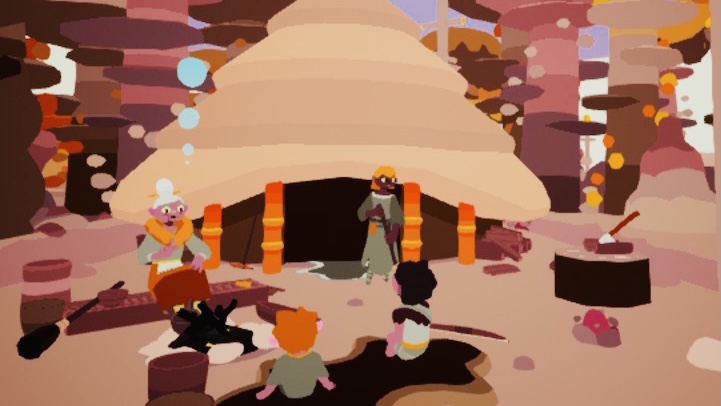
I’ve already written at length about how much I loved I Am Dead (Hollow Ponds, 2020) as an archaeologist and as a museum worker. However, I want to discuss another element of the game a bit further – more specifically, the final level, in which the player moves between the present and the past, using the remains of Prehistoric peoples to access their memories and experiencing the far past through them. Of course, in-game this time-traveling adventure is not too much of a leap in fantastical logic – you are playing as the ghost of a deceased museum curator who can read thoughts and view personal memories, after all! But this final level is certainly a new extension of this logic, as previously you’ve only been able to interact with the thoughts and memories of living peoples. Like the rest of the game, the purpose of uncovering these memories is to identify important moments relating to a particular person’s life – however, in this case you’re actually searching through the collections of a museum and finding artefacts that correlate with these memories, leading to some interesting tensions between the interpretations of artefacts versus their realities (including one particularly important artefact that gets tossed into a box of miscellaneous rocks).
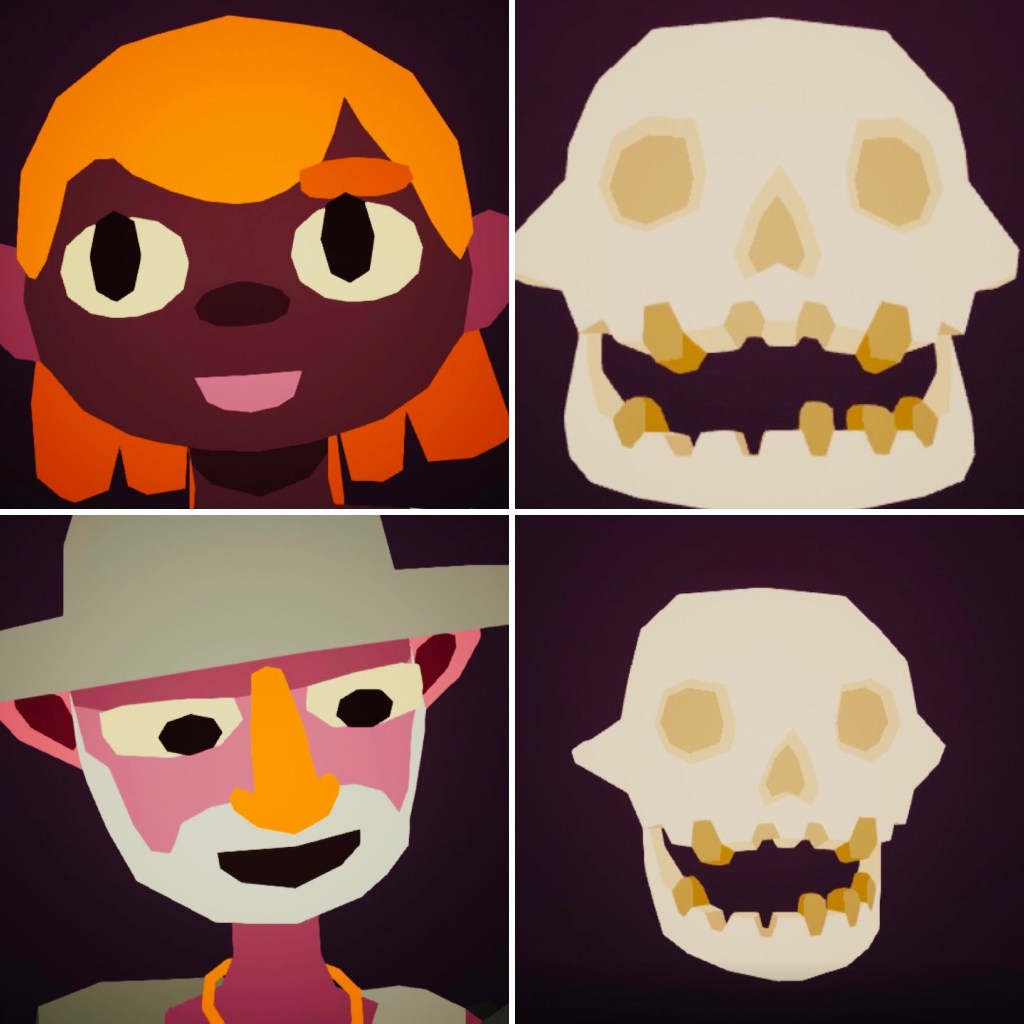
To step away from the in-game logic, however, I’d like to focus on the mechanics of this level and how we can contextualise it in the real world. The moment I got to this level in the game, I immediately thought of real life attempts at reconstruction of the past. This is a bit of a wide field within archaeology and the broader heritage sector that ranges from artistic interpretations of archaeological sites “as they were” in the past (Hodgson 2002), forensic reconstructions of past peoples based on their skeletal remains (Conti et al. 2022), and even digital interpretations of the past using technology (Puig et al. 2020).
In some ways, I think you can argue that fictive narrative is the next step after physical reconstructive work in developing an immersive and engaging reconstruction of the past – whereas the physical reconstruction provides manifestations of the setting and characters involved, producing a narrative can propose actions and situations that are relatable for the viewing public. And this has been the crux for many arguments in favour of using fiction and storytelling as part of archaeological interpretation and dissemination – that these creative approaches could be more successful in engaging non-specialist audiences than other forms of archaeological public outreach (Gibb 2000, Mickel 2012, Fitzpatrick and San Filippo 2017). Archaeologists are in many ways more uniquely equipped than other scientists and scholars to apply our work to a narrative structure, as we are already doing something similar when we incorporate archaeological data into an interpretation.
To bring zooarchaeology and environmental archaeology into the discussion, fictive narrative could also be a way of exploring non-human experiences of the past – indeed, this is somewhat touched upon in the game as well, as you can unlock the memories of animals (albeit recent ones, not of the deep past). It’s an interesting way of showcasing the influence of all living things on the environment and resulting archaeological record – and could potentially be a means of generating more non-anthropocentric narratives of the past, recognising the agency of non-human species and following in the footsteps of zoontological, post-humanist work currently being undertaken within zooarchaeology (Boyd 2017).
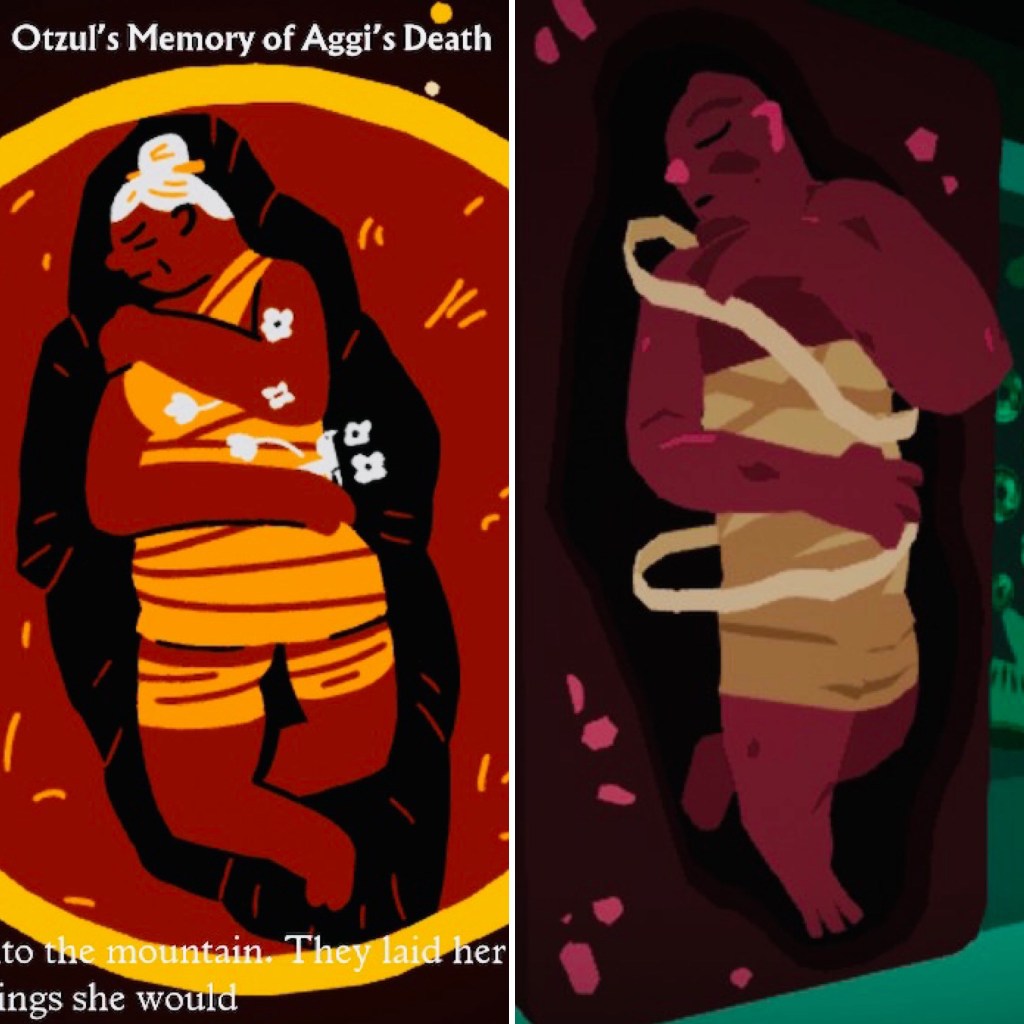
I think this level in I Am Dead can be viewed as an example of how developing a narrative through archaeology can be used as a means of increasing engagement and developing a deeper understanding of the archaeological record – although in this case what we are seeing is the “truth” of past events, the general concept of just viewing scenes of the past in which people were not only just living their lives, but engaging amongst themselves and with their environment, invites us to relate to these long-deceased people and recognise our shared humanity. In I Am Dead, we see how prehistoric people raised families and got into interpersonal conflict, how they passed down knowledge and did certain things that they believed to be essential for their survival. And despite the differences that exist between us as present day people and them existing in the past, we can recognise the shared ideals, hopes, and aspirations in their actions – we may not understand the specifics (for example, during these visits to the past we see a variety of ritual acts that are not given further explanation), but we understand enough to digest the story unfolding before us.
Unlike the game, in real life we can’t actually access the memories of the long dead to truly experience life in the past – as such, we make do with what we have available through careful archaeological excavation and interpretation. Of course, the reconstructive process is not perfect and has many critical considerations to make with regards to replicating modern day bias in reconstructing the past (Nieves Delgado 2020, Maass 2022). But perhaps in invoking the more abstract (thoughts, feelings, dreams) through creative writing and storytelling, we further expand the potential for seeing the similarities between ourselves and people from the past, and thus can humanise and perhaps even contextualise the past further than we could before.
You can buy I Am Dead now for the Nintendo Switch or for PC via Steam.
References
Boyd, B. (2017). Archaeology and human–animal relations: Thinking through anthropocentrism. Annual Review of Anthropology, 46, 299-316.
Conti, V., Rodella, L., Del Vesco, P., Zink, A., Manzollino, R., & Paladin, A. (2022). Face to face with human remains: the case study of an Egyptian mummy’s facial reconstruction. In Le scienze ei beni culturali: innovazione e multidisciplinarietà.
Fitzpatrick, A., & San Filippo, V. (2017). Things Worth Telling: Considering Narrative Storytelling in Environmental Archaeology. Theoretical Archaeology Conference (TAG). 18-20 Dec 2017. Cardiff, Wales.
Gibb, J. G. (2000). Imaginary, but by no means unimaginable: storytelling, science, and historical archaeology. Historical Archaeology, 34(2), 1-6.
Hodgson, J. (2002). Archaeological Reconstruction: Illustrating the Past. IFA Paper (5). Reading, UK: Institute of Field Archaeologists.
Hollow Ponds (2020) I Am Dead, video game, Nintendo Switch. West Hollywood, CA: Annapurna Interactive.
Maass, C. K. (2022). Race, Gender, and Intersectionality in the Bioarchaeology of the African Diaspora: Perspectives from Colonial Peru. Journal of Archaeological Method and Theory, 1-23.
Mickel, A. (2012). The novel-ty of responsible archaeological site reporting: how writing fictive narrative contributes to ethical archaeological practice. Public Archaeology, 11(3), 107-122.
Nieves Delgado, A. (2020). The problematic use of race in facial reconstruction. Science as Culture, 29(4), 568-593.
Puig, A. et al. (2020). Lessons learned from supplementing archaeological museum exhibitions with virtual reality. Virtual Reality, 24, 343-358.
Please click here to donate to fundraisers that are directly helping people currently in Gaza.
You can also donate to help out marginalised archaeologists in need via the Black Trowel Collective Microgrants. You can subscribe to their Patreon to become a monthly donor, or do a one-time donation via PayPal
 Animal Archaeology
2 responses to “Dreaming of the Past: Using Narrative & Fiction to Understand Archaeology in “I Am Dead””
[…] Dreaming of the Past: Using Narrative & Fiction to Understand Archaeology in “I Am De… Please note that this blog post contains spoilers for the game “I Am Dead”. An example of one of the memories accessed from the prehistoric past, showcasing family life back then. I’ve already written at length about how much I loved I Am Dead (Hollow Ponds, 2020) as an archaeologist and as a museum worker.… […]
LikeLike
[…] Dreaming of the Past: Using Narrative & Fiction to Understand Archaeology in “I Am De… Please note that this blog post contains spoilers for the game “I Am Dead”. An example of one of the memories accessed from the prehistoric past, showcasing family life back then. I’ve already written at length about how much I loved I Am Dead (Hollow Ponds, 2020) as an archaeologist and as a museum worker.… […]
LikeLike