Please note that this blog post has some slight spoilers for Danny Boyle’s 2025 film 28 Years Later. Read ahead at your own risk!
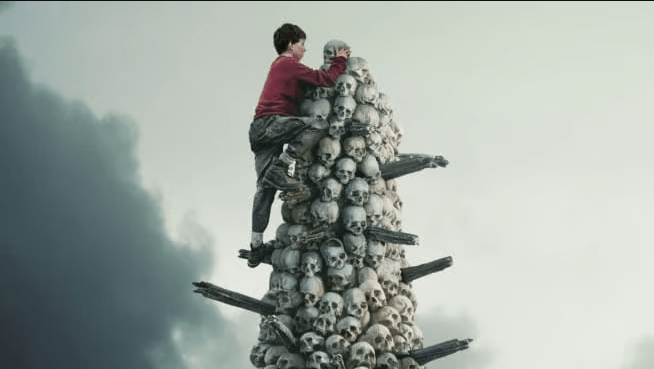
In the final act of 28 Years Later, the audience is introduced to Ralph Fiennes’ character Dr Ian Kelson, a former GP who is thought to have lost his mind in the intervening years since the original outbreak of 28 Days Later (2003). Evidence to this is initially presented in the form of a massive monument made of the skeletal remains of the dead.
For many members of the audience, this is likely a shocking and gruesome display at first; it plays on contemporary attitudes to the dead, which amongst many cultures have become quite detached from the realities of death and decay. The notion of physically handling, defleshing, and disarticulating the remains of a human being – let alone a loved one – is likely taboo for many audience members, so it is unsurprising that such an act might be viewed distastefully.
The film eventually presents Kelson’s ‘Bone Temple’ as a form of memento mori, a reminder to the living of their own mortality. Following the death of Isla, mother of the film’s protagonist, Spike, Kelson prepares her remains to be added to the monument. He gives her skull to Spike, who is able to say his final farewell to his mother while placing it atop the tower of skulls.
It’s a really beautiful moment of love and grief, demonstrating an emotional intimacy with the dead that is otherwise non-existent as the rest of Britain struggles to survive amongst the Infected. But it’s also part of a long line of changing funerary traditions across the isles as well, which have historically included similar practices of disarticulation and display.
The use of ossuaries and charnel houses to store human remains are seen throughout medieval and post-medieval Europe (Farrow 2021), including England (Craig-Atkins et al. 2019; Barnwell et al. 2023). However, I want to focus more on the funerary traditions of later prehistoric Britain which share similarities to the practices depicted in the film.
This period of time (which includes the Late Bronze Age and the Iron Age) does not appear to have a dominant form of funerary practice (Brück 1995), which suggests that perhaps there was a diversity of practices occurring across Britain instead. Identified amongst these are ones that are in practice to this day, such as cremation and inhumation, as well as rites of excarnation.
‘Excarnation’ refers to the process of removing flesh from skeletal remains, leaving bones disarticulated from each other. There are many different ways to undertake excarnation of the dead: through exposure to the environment (Madgwick 2008, p. 3) and scavenging species (Smith 2006, p. 671), through the use of structures made to protest remains during the excarnation process (Hartwell 2002), within sheltered spaces such as caves (Dowd 2008, p. 309), and even through manual methods (Robb et al. 2015).
Within the Covesea Caves of Scotland, excarnation has a long history of practice – likely done through protected exposure before being completed by hand before being bundled up within animal hide (Armit and Büster 2020, p. 246). Archaeological evidence suggests that these remains were periodically visited and tended to by living descendants and community members, with rituals and small feasting occurring amongst the dead (Fitzpatrick 2020). While we cannot give the exact reasons as to why these traditions existed, we can assume that the relationship between the living and the dead was crucial to the beliefs of later prehistoric people, with continued access to the deceased an important part of everyday life.
In 28 Years Later, we see manual excarnation in action – Kelson appears to use a form of maceration to deflesh the remains and disarticulates them, allowing for skeletal elements to be separated for display. In the deep past and the (fictional) present, we can view this act as one of deep care and connection – while Kelson isn’t necessarily a predecessor of those interred in his Bone Temple, he clearly holds them in community and ensures that they are remembered as part of his massive memento mori.
The meticulous act of transforming a body from the living to the dead through excarnation is itself a ritual – of mourning, of grief, of interconnectedness, of transition. While we cannot know the minds of those in the past, we can imagine how maintaining such an intimate relationship with their dead could have such a fundamental impact on how they view death and community, as well as life and memory.
I have no idea if writer Alex Garland knows that this practice is actually part of a long line of funerary traditions found across the British Isles, but as context it really does add further depth to that scene in the film. 28 Years Later speaks so much to how we transform and reinterpret culture and history, I find it fitting that much of the emotional core of the final act centres around a practice that was once a fundamental element of cultures in Britain. That there is a deep need for humans to grapple with death, to be able to make it tangible in a way that enables us to move forward less afraid of the future and with deeper connections to those who came before us.
References
Armit, I. and Büster, L. (2020a) Darkness Visible: The Sculptor’s Cave, Covesea, from the Bronze Age to the Picts. Edinburgh: Society of Antiquaries of Scotland.
Brück, J. (1995). A Place for the Dead: the Role of Human Remains in Late Bronze Age Britain, Proceedings of the Prehistoric Society, 61, 245–277.
Barnwell, P.S., Craig-Atkins, E., Crangle, J., and Hadley, D.M. (2023). Medieval Charnel Houses: Resurrecting Lost Medieval Rites. Journal of the British Archaeological Association, 176(1), 270–295.
Craig-Atkins, E., Crangle, J., Barnwell, P. S., Hadley, D. M., Adams, A. T., Atkins, I., McGinn, J., James, A. (2019). Charnel practices in medieval England: new perspectives. Mortality, 24(2), 145–166.
Dowd, M. (2008). The Use of Caves for Funerary and Ritual Practices in Neolithic Ireland, Antiquity, 82, 305–317.
Farrow, T.J. (2021). Relics of (the) People: Ossuary Remains in Postmedieval European Folk Practice. The Enquiring Eye: Journal of the Museum of Witchcraft and Magic, 5, 1-15.
Fitzpatrick, A. (2020). Ritual and Funerary Rites in Later Prehistoric Scotland: An Analysis of Faunal Assemblages from the Covesea Caves. PhD Thesis, University of Bradford.
Hartwell, B. (2002). A Neolithic Ceremonial Timber Complex at Ballynahatty Co. Down, Antiquity, 76, 526–532.
Madgwick, R. (2008). Patterns in the Modification of Animal and Human Bones in Iron Age Wessex: Revisiting the Excarnation Debate. In O. Davis, N. Sharples, and K. Waddington (eds) Changing Perspectives on the First Millennium BC. Oxford: Oxbow, 99-118.
Robb, J., Elster, E.S., Isettie, E., Knüsel, C.J., Tafuri, M.A., and Traverso, A. (2015) Cleaning the Dead: Neolithic Ritual Processing of Human Bone at Scaloria Cave, Italy, Antiquity, 89(343), 39–54.
Smith, M. (2006). Bones Chewed by Canids as Evidence for Human Excarnation: a British Case Study, Antiquity, 80, 671–685.
If you’re financially stable enough, why not donate to help out marginalised archaeologists in need via the Black Trowel Collective Microgrants? You can subscribe to their Patreon to become a monthly donor, or do a one-time donation via PayPal.
Please also consider donating to fundraisers for Palestinians currently in Gaza by clicking here.
 Animal Archaeology