Kinda! Okay, so real life museum work doesn’t usually involve collecting poltergeists and we don’t often have groups of clowns regularly visit (at least, not in my experience). Two Point Museum (Two Point Studios, 2025) is obviously full of charming bits of nonsense that have been found throughout the simulation video game franchise. And yet, I think the heightened reality actually helps bring to light some of the overarching issues that we face in the museum sector in a way that’s much more fun to engage with than in real life (and perhaps, more importantly, without the immense pressure and stress that has been following me around since I became a museum researcher a few years ago!).

I’ve previously written about how games relating to archaeology and other forms of heritage work often simplify these nuanced and careful practices into easily understandable gaming mechanics and Two Point Museum is no exception. While real world museums are often intricate systems made up of a diverse group of specialists and professionals, Two Point Museum has flattened much of this work to be part of the curator’s (aka you, The Player) responsibilities – if you’d like to learn more, Jini Maxwell (2025) has written a fantastic review of the game from their perspective as a curator which really looks at this particular element of the gameplay.
Ultimately, your museum skills are being scored across several factors, the main ones being Buzz, Decoration, and Knowledge. In other words, the game is looking to see if your exhibits can be engaging, look good, and teach your visitors a thing or two. A couple of things can directly impact these factors – haven’t refurbished your dinosaur skeleton in a while? That lowers the Buzz of the exhibit. Is the only thing ‘decorating’ your newly acquired cursed mannequin a rock? Yeah, definitely not going to attract new visitors. No information stand near your giant, carnivorous plant? Well of course no one is going to learn anything from that!
Alongside these things, you also have other factors to worry about: museum income, visitor satisfaction, and staff happiness. You also have to worry about escaping poltergeists, but I feel confident in saying that’s very much a rare occurrence in the real world sector.
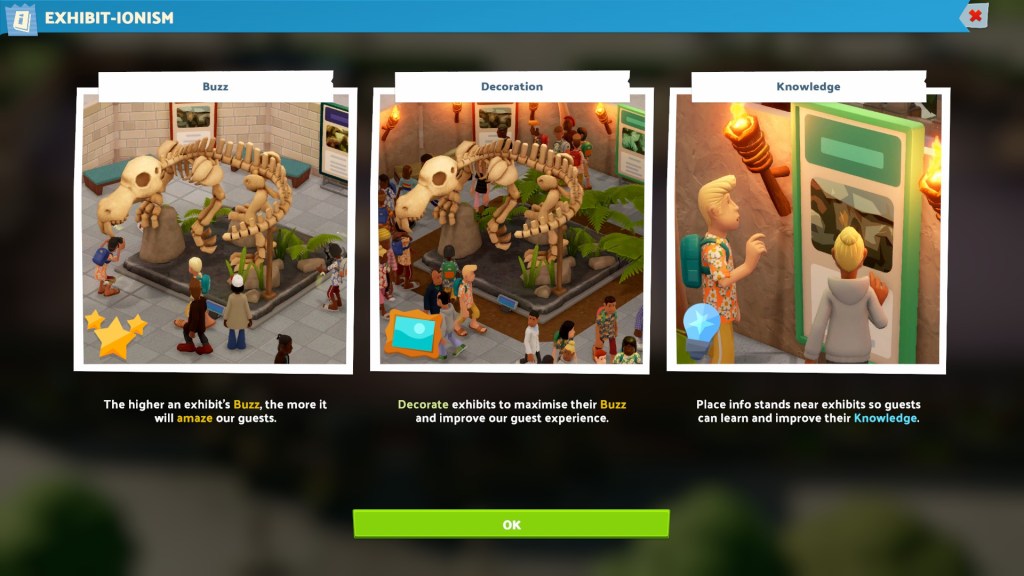
The tensions between these elements are where some of what I find to be a bit more true to museum life comes into play. As someone who has recently worked on their first interactive museum exhibit, I learned firsthand that there is a lot of work that goes into carefully balancing education and fun, making exhibits interesting enough to not only catch a visitor’s eye, but also keep them around enough to learn something new. In developing our exhibit, we had to figure out how to employ fun interactive moments that also told the story we wanted to convey to visitors – I definitely had a few proposals get dropped as they just weren’t engaging enough!
Of course, the solutions in Two Point Museum are often much simpler – for example, I just needed to purchase a few fake plants and some fossil decals to turn a fossilised starfish display into one of my most popular exhibits! – but the overall problem of how we best meet these various needs of our visitors (to be entertained, engaged with, and educated) is more or less the same.

It’s also been interesting to try and play this game true to my own real world ethics as a museum worker as well. As someone who has never been particularly great at the financial parts of these simulator games (I blame my early introduction to money cheat codes via The Sims), it didn’t take too long for my museum to start losing money. Frantically, I looked at my options – I could fire some staff and refuse some raises? I could raise the prices of entry and food? I could even…ugh, sell some of my exhibits to private collectors.
None of these options greatly appealed to me (although I may have raised my prices a tiny bit…), so I looked at my other options – I could take out loans, or I could consider sponsorships. I went with the latter, thinking that at least some merchandise sponsorship couldn’t be too bad, right? Well, unfortunately that also included that I put a sponsored exhibit into my museum as well – one that had no real educational value, didn’t fit in with my museum at all, and actually decreased visitor enjoyment too. But listen…I really needed the money!
This situation again echoes some of the difficulties that museums currently find themselves in, with many here in the UK facing major financial challenges (Museum Development South West 2024, p. 86). Still grappling with not only financial losses during the pandemic, but also years of austerity and underfunding, it is perhaps not entirely surprising that museums have turned to problematic sponsorship and taking money from unsavoury if not violent, oppressive organisations (Greer 2024).
In retrospect, I think the inclusion of this sponsorship in Two Point Museum is very much recognition of the current situation as well – not only does it explicitly decreases visitor enjoyment, but you’re literally hawking a “all natural two-in-one perfume and engine coolant”…maybe not too far off from some of these greenwashing sponsorships in real life! But hey, at least I didn’t sell off my exhibits to make some money, given that seeing your collection as financial assets technically is in violation of the Museum Association’s Code of Ethics!

So while a lot of what rings the most true to me comes from in-game problems and tensions, I do also want to point out that there are some elements that I kinda wish were actually more embraced or widespread in the sector (and are much more achievable in-game than in real life, of course!). For example, a major gameplay mechanic involves launching expeditions – this is the main way in which you are able to obtain new exhibits.
Now, expeditions and fieldwork have historically been an integral component of museums in the Global North, particularly between the 1890’s and 1930’s when this became a major form of colonial era acquisitions for natural science and anthropology collections (Bell and Hasinoff 2015, p. 1). Today, some museums (particularly natural history and science-focused museums) continue to led fieldwork around the world, including the Australian Museum, the UK’s Natural History Museum, and the Natural History Museum of LA County.
But while most museums will undertake some form of research (whether internally or through external collaborations and partnerships), their capacity is often limited based on funding, staff, and a lack of other resources. For example, in the UK, very few museums hold Independent Research Organisation (IRO) status, which means that most museums are ultimately unable to apply for the bigger grants that are awarded by the country’s main research councils (Simpson 2023, p. 81).
I do wish undertaking – and leading on – research and fieldwork was a much more accessible activity for all museums. While I want to acknowledge that many museums are creatively finding new ways to undertake research despite tightening budgets, I can only imagine the possibilities unlocked by expanding our research capabilities, particularly across departments and beyond our institutional borders. And I think that even Two Point Museum explores that a bit as well – expeditions aren’t just relegated to your institutional experts (although they often lead them), but will sometimes require other members of staff as well. Opening up the traditional siloes of collections work is an under-utilised approach, although one that has been promoted as good practice for more dynamic and empowering approach to collections (Museums Association 2020, p. 10). It’s genuinely awesome to see that this has been adapted by a funny little video game, to be honest!
So to answer the initial question posed by the title of this blog post is yes – in some ways, Two Point Museum is actually pretty accurate to the experience of working in museums. It may be a bit more biased towards ghosts and gigantic, carnivorous plants (again, only based on my own experiences – not sure about some of your museums!), but the problem-solving elements certainly ring quite true for me. And while the game itself can be humorously fantastical, there are also elements of the game that I think would be an ideal practice in the real world, too. Maybe if we can force some government officials to play it, we can convince them that actually, our sector could so with some much-needed funding…
You can buy Two Point Museum now for PC on Steam, on Xbox, and on the PS5.
References
Bell, J.A. and Hasinoff, E.L. (2015) Introduction: The Anthropology of Expeditions. In JA Bell and EL Hasinoff (eds) The Anthropology of Expeditions: Travel, Visualities, Afterlives. New York: Bard Graduate Center. pp. 1-32.
Greer, B. (2024) Just Stop the Right’s Defending of Art and Culture will Stop Selling Itself to Oil. The New European. https://www.theneweuropean.co.uk/just-stop-the-rights-defunding-of-art-and-culture-will-stop-selling-itself-to-oil/
Maxwell, J. (2025) Two Point Museum: A Curator’s Perspective. Games Hub. https://www.gameshub.com/news/features/two-point-museum-a-curators-perspective-2684185/
Museums Association (2020) Empowering Collections. Museums Association. https://www.museumsassociation.org/campaigns/collections/empowering-collections/
Museum Development South West (2024) Annual Museum Survey 2024. Museum Development England. https://southwestmuseums.org.uk/what-we-do/annual-museum-survey/england-2024-reporting/
Simpson, K. (2023). Tacking the Climate Crisis: an Overview of UK Museums. In N Merriman (ed) Museums and the Climate Crisis. London: Routledge. pp. 72 – 92. https://doi.org/10.4324/9781003347606-6
Two Point Studios (2025) Two Point Museum, video game, PC. London: SEGA Europe.
If you’re financially stable enough, why not donate to help out marginalised archaeologists in need via the Black Trowel Collective Microgrants? You can subscribe to their Patreon to become a monthly donor, or do a one-time donation via PayPal.
Please also consider donating to fundraisers for Palestinians currently in Gaza by clicking here.
 Animal Archaeology